Blog
May 17th, 2012 by Niilo Autio
With the expected launch of the new iPhone just around the corner, the gadget blogs are rife with speculation, discussion and alleged confirmations of a new 4″ screen as its main feature. Some sources are suggesting a new display resolution of 640 x 1152 at an aspect ratio more fitting of HDTV content, while maintaining physical hardware dimensions similar to the iPhone 4/4s. We decided to see how some applications would benefit from the additional real estate. The images below compare the rumoured new screen size with that of the existing iPhone 4/4s.
December 20th, 2011 by James Wilson and Leslie Jennings
December 1, 2011, Toronto Ontario
The Burgess Shale, tucked into British Columbia’s Yoho National Park, is arguably the world’s most significant fossil field. Thanks to its exceptional preservation and over 125 years of quarrying expeditions, research from this field continues to inform our understanding of evolution. Since launching on December 1st, this world-class resource continues to garner plenty of kudos with the media, paleontologists and users at large.
The bilingual website showcases Canada’s Burgess Shale fossils dating back over 500 million years. Considered to be the most current and comprehensive knowledge base on the subject, this resource features an authoritative fossil gallery including almost every Burgess Shale species ever described, weighing in at approximately 200 species. The creatures are brought to life by a rich collection of high-resolution images with digital reconstructions for over 70 species.
The Royal Ontario Museum, together with Parks Canada spearheaded the website thanks to a Virtual Museum of Canada (VMC) grant. Once the ROM’s VMC bid had been approved, Overdrive was chosen to design and implement the website in March 2010.
“The website was a huge undertaking”, said Overdrive principal James Wilson. “The site encompasses a fossil gallery of more than 1600 images. There is in-depth, searchable information, not to mention maps, timelines, 3D animations and video. The ROM wanted this to be the pre-eminent Burgess Shale website, the go-to resource for educators, the public and even specialists. Dr. Jean-Bernard Caron, Curator of Invertebrate Palaeontology at the ROM, who oversaw the content development on the website had a significant wish list, and our job was to make it all happen.”
Said Caron of Overdrive’s contribution, “You read our minds and provided exactly what we needed the first time around.”
Some challenges beyond the scope of the project included: significant expansion to various sections within the site and also accommodating multiple rounds of revisions to the 200,000+ word website in both official languages. Additionally, part of the mandate of the VMC is to ensure all funded projects are accessible to all. That means information must be equally available and meaningful to users with visual or auditory impairments. “We learned the rules on our first VMC project, The Cobalt Mining Adventure”, said Wilson, and applied what we learned to streamline the build for the Burgess Shale. We were gratified to receive the shortest second final review ever achieved by a Canadian Heritage Information Network member.
To view the project, visit Overdrive (Design Limited).
For more information on the Burgess Shale project read the PRWeb release.
Lauren Schneider
Royal Ontario Museum
416 586 5547
Omar McDadi
Parks Canada
403 522 1277
December 19th, 2011 by James Wilson and Leslie Jennings
In lieu of sending out seasonal cards this year, Overdrive has decided to contribute to Plan Canada to sponsor a girl’s education for a year.
This gift is about more than changing the life of one girl. It’s about changing her destiny—and the destinies of those around her. Education helps young girls reach their potential. It helps them see that marriage and early motherhood aren’t the only options. Investments in women’s and girls’ education and health yield some of the highest returns of all development investments, including reduced rates of maternal mortality, better educated and healthier children and increased household incomes.
If you’d like to know more about Plan, check it out here.
Happy Holidays, and renewed prosperity for all in 2012 from all of us at OD.
April 11th, 2011 by James Wilson and Leslie Jennings
Do you ever watch commercials on TV and think, OMG someone got paid for that. Real cash money. Pay the mortgage money. Send your kid to college money. As you shake your head with consumer outrage, simultaneously you experience a transcendent ABBA moment, thinking why don’t those advertisers take a chance on me?
I’ve done just about everything in the design biz in the past 30 years. In addition to the stock and trade of IDs, print and digital work I’ve shot video, been in recording studios and edit suites, created storyboards, produced animations. But I’d never been called on to put all the bits and pieces together to produce television spots.
Then one of our clients, who we’d done visual identity work for, wasn’t quite getting the creative they wanted from one of their agencies. They asked us for some storyboard variations on a piece of their regular media work. Nothing epic; a financial sector company looking to make their messaging work a little harder. We delivered some roughs, and the client was pleased. “Let’s do it,” they said and as is my way, I jumped in with both feet. I said yes without entirely knowing the complete panorama of what I was up against, but I knew enough of the landscape to make intelligent assumptions of how to put the bits and pieces together.
In other words, diving in on a wing and a prayer can often be disastrous but with a bit of experience and a few tools (rather than none) at your disposal you have a better chance of getting out un-bloodied.
Even though I hadn’t done commercial television production before, I’ve been in the biz long enough to know the right people I would need to make a go of the project. You can’t do everything yourself and because of that it’s important to have the skills to make the right choice of talent. If you’re unsure about who you’re hiring then don’t. Rule of thumb is, rely on relationship, hire the right people and then let them do their job. And so the team was assembled.
I knew that I wanted to approach the commercial from a mix of live action and animation. Synchronicity takes a hand too here. Recently we’d pitched an irreverent illustrative approach of delivering complex information to another client who had thought it was clever, but too risky for their campaign. The work had been created by a talented illustrator named Ben Weeks who has a humorous, unembellished down-to earth style that I thought could provide a great contrast to our client’s information dense message.
With the hope of grasping success from the jaws of failure, I pitched Ben’s approach to the new client, which is a true juxtaposition of basic illustrative style and message. One contrasting the other to create emphasis and loosely based along the line of Apple’s irreverent style which works because their UX and brand is so buttoned down. Fortunately, we were working with a firm that although, not as large as Apple, was equally solid in their offering. Moreover, they were willing to make just a little leap of faith.
The concept was approved. On we went through the production process. Like mushrooms in the night one commercial turned into four then into eight – all in just over two and a half weeks. Straight into the fry pan.
So here’s what I picked up through the tortuously fun process.
1) Script changes at the eleventh hour are dodgy, especially when they have to be translated into French. What this reminds us is to build more time into the production schedule. (Surprise!) This allows for such niceties as having a final script ready for the talent before they go in the sound booth. We were able to cover that with a bit of experience on our end and by observing point 3 below.
2) Two and half weeks is not enough time to produce eight commercials: two concepts, in 15 and 30 second flavours, English and French. Again, more time. Way more time.
3) Use union talent – the best you can afford. Not only do you get a better outcome, when you book a pro, you get someone who can handle a mutating script with savvy and skill. Although we all like to think we could be actors if we wanted to, it really is worth the extra $$ to get the real thing.
4) When ever possible, limit the use of text on screen. Keeping track of continuity between eight different versions of English and French can be crazy making, especially when last minute changes occur. Better to leave this kind of typography to print. And, just in case you were wondering, it helps to be bilingual when you’re editing French.
5) Television commercial production is as excruciatingly boring, yet stressful, nit-picky and time consuming as commercial photo shoots, requiring the same amount of commitment and focus as a short documentary or feature film.
6) Here are my credits. Voice talent: Daniel Fathers (English) and Denis Pelletier (French) through Noble Caplin, Abrams, DOP (director of photography): Iris Ng, Director and Post Production: Andrew Kines at Slick Slack, Sound Studio: Optix, Mastering: S&S, Lighting and grip: Christopher Godin, Illustration: Ben Weeks, typography: Alex Rosa and Niilo Autio at Overdrive, Jason Gerard, Andrew Kines and Ben Weeks doing the hand modelling thing and me doing what I do, getting up early, staying up late and making my family miserable.
7) As humans, we all swim in the same pool (Earth). When we were mastering and recording to tape there was no tape media left in the city due to the disaster in Japan. My question to this was, “How is anyone making commercials if the broadcasters require media?” I never did find out the answer but we were lucky enough to score the last few pieces of tape from a small shop in Scarborough with less than a day to spare before delivery to the broadcasters. One more reason to say that my country includes the place where I was born and raised. The tapes were being delivered to S&S for mastering as Andrew was simultaneously enroute to make the rendezvous. And by the way, I’ve been told that the reason people still use tape in this day and age is that it is indicative of a certain rigour in production to produce tape as a final product.
One last note. Thanks to Horizons ETFs, our client. They took a chance. It didn’t mean the life and death of the company but they took the chance nonetheless. They were supportive and intelligent with their opinions. They had their input but they exercised good management 101 – choose your suppliers wisely, don’t micro-manage and let the people that you hired for their expertise earn their money. We did that for sure.
November 22nd, 2010 by James Wilson and Leslie Jennings
or “The Origin of Ideas, Inspiration, Subliminal Influence, Co-incidence and Plagiarism”
Where do ideas come from? The creative spark is rarely ignited in a vacuum. I draw inspiration from my training, travels, my bicycle, my family, nature – from life. The world is just awesome. (Have I heard that somewhere before?)
When it comes time to design an identity, let’s say, I start with a brief from the client. (I’m covering briefs in blog #3 with examples of what good ones look like and what most of them look like.) What are the needs of the client? What do they like? Dislike? Then I take the single most important next-step in the process and that is to open a sketchbook and pick up a pencil. Then I make a list of pertinent words that underline an approach. Then I sketch, then go away and have a little lunch, then sketch, then take a walk, then sketch, then go grab a shower.. you get the point. I haven’t opened up any annuals or looked at anything on line (…yet.), and that’s because I firmly believe that “napkin sketches” and “blue skying” are essential to producing original work. Blue skying primes the pump but sketching on paper accomplishes a number of specific things:
a) it shows process and paper trail. It’s analog baby but it’s the real thing
b) it’s a perfect medium for happy accidents, free association and the rapid and fluid development of ideas
c) it’s an “outbasket” for crap. If the crap is staring back at you from a printed page then it’s cleared from your head. It limits the possibility of you revisiting it and allows your brain to move on.
Sketching lays the foundation for a solid idea because the visuals are devoid of colour and finessed form and therefore lays bare a good idea (or a bad one) in a chicken scratch. Once you identified a keeper or two all you’ve got to do is spread your arms and fall backwards off the cliff. Gravity will do the rest. With this in mind I always advise younger designers to resist jumping into technology at the outset of this process. The computer can often make detail “precious” early in the design cycle resulting in the designer not being able to let go of it to the detriment of the big picture. In my experience, the latter process inevitably results in an unresolved outcome – a product that lacks a sense of rightness or completeness.
The point is you need to work out the kinks and certainly before you turn to reference. Sometimes clients have parameters that limit the type of options we can explore, but most of the time if you follow this process you will end up with something that both the client and yourself can be proud of. More importantly it is something original and non-derivative. Having said that, shit still happens.
Such was the case with an identity I created for VisualSonics, a medical imaging startup in the life sciences space, now all grown up and acquired by US firm this past July. (as a side note, the parent company has left the original identity intact which usually means good brand equity in the marketplace). At the time I was working for a man who turned out to be a good client (also blog #3) and whom I’ve subsequently ended up working with pretty steadily since. In the development stages of the ID together we reviewed the roughs, vetted the choices, developed the preferred approaches, finessed, and finally narrowed the choice down to one logo which I fine tuned into something that the company was happy with. The process took several weeks. This is what it looks like accompanied with the rationale behind it.

VisualSonic’s core competency is in the micro-imaging of small mammals that are genetically engineered to be predisposed to specific diseases. Their imaging techniques work on a near cellular level. The logo is based on several elements.
1) the matrix of dots represents organized cellular structure.
2) the black organic shapes represent both biology and a “V”
3) the black shapes superimposed on the “cellular structure” represent identification or bringing something into focus
A week later one of the designers in the studio showed me this.

Needless to say I was alarmed and horrified. The first thing I did was paste the logos into a single file side by side for comparison purposes, sent it to the client, followed up with a phone call and waited with bated breath for the response. He opted to stick with the identity we had in place. His comments: he’d seen the process (chalk up one for point a), understood how the identity had evolved into it’s final form (chalk up two for point a), and was comfortable keeping it as it stood (hat trick). It didn’t hurt that the other logo was for a totally different industry sector. He was OK, but I was still scratching my head. What happened? Was it co-incidence? Did two designers come up with congruent solutions for different products through their own independent thought processes? It happens. What niggles is I can’t help but wonder if I saw that logo at some point during my own development process. I don’t remember seeing it, but maybe somehow, unconsciously the image wiggled its way into the creative crucible. It made me uncomfortable – and it should. Our ideas are our stock and trade and need to be protected. It’s happened to me three times in 25 years but it’s a risk worth taking in the ongoing quest to produce original work in my opinion.
I see things all the time that remind me of work I’ve done or of someone else’s work that looks like someone else’s work. An illustration, say that looks very close to an illustrative style that I thought I was the first guy to use. Or some concept that seems just a tad too close to one I’d done the season before. They’re not exactly the same, but they give me pause for thought. I give them the benefit of the doubt, hoping that like me, they have their process, their road map, documented. Recently however I came across something that crossed the line, eliminating any benefit of the doubt. One of the designers in our studio sent me a link to this page from a Communication Arts illustration annual. He just showed it to me but didn’t say anything.
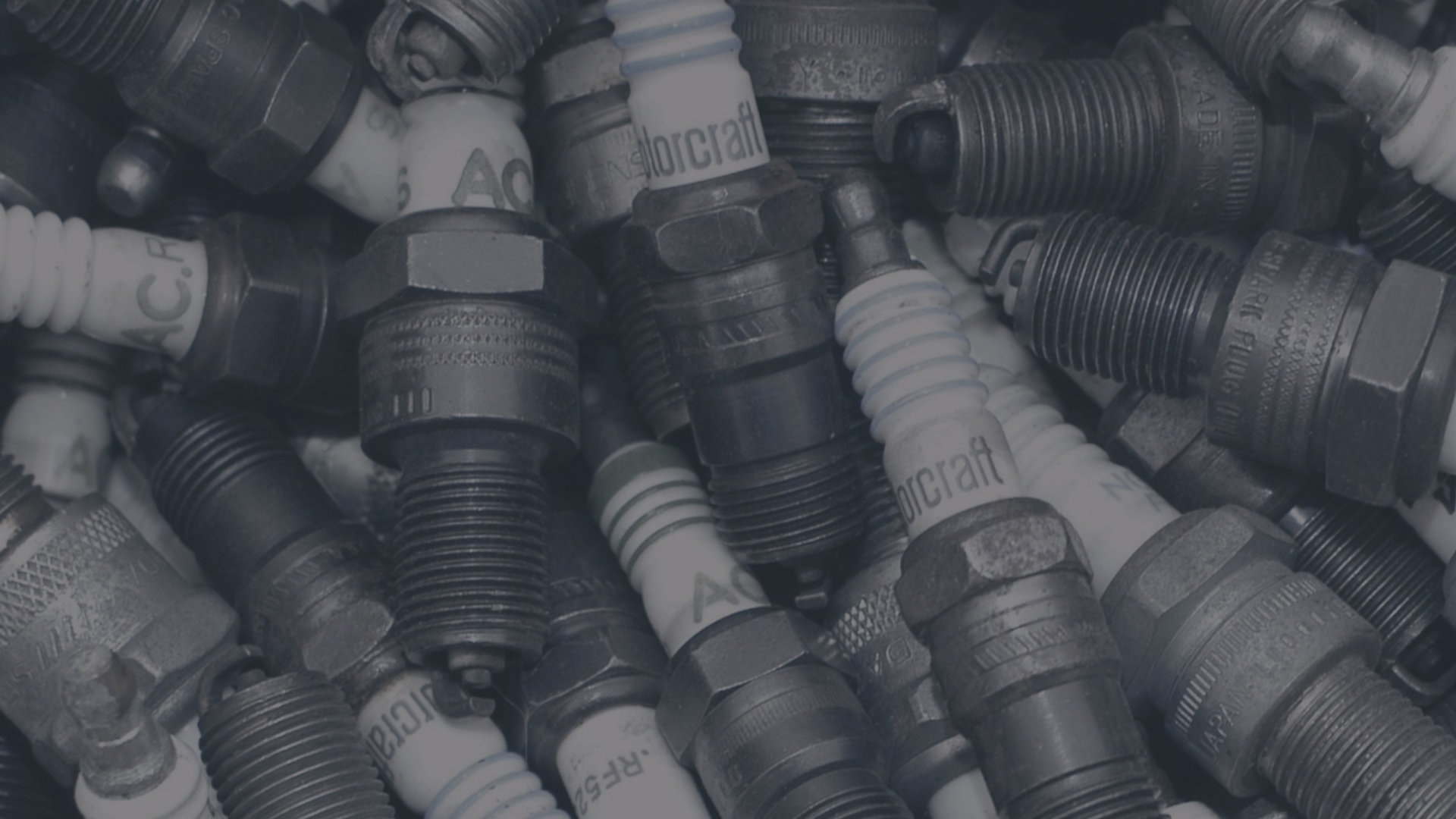
It had an uncanny resemblance to a little something the studio had designed a few years back for a client close to my heart. Me! The centrepiece of our own identity, this image didn’t just remind me of my own beloved sparkplug, it was the exact same thing. We had spent a billion in-house hours getting to, then creating that spark plug. It’s a composite of a number of different actual spark plugs and we built it from scratch in 3-D software and rendered it. To me it was like the perfect spark plug proportion wise, some elements emphasized and some simplified while remaining realistic. Our identity had been published in a Com Arts design annual previously and now, here it was again in the same publication, winning an award for someone else. I put an overlay of my original over the newcomer, and voila:

Above left to right: The illustration as published in Communication Arts Illustration Annual 48. The illustration with our sparkplug superimposed on it and our sparkplug as it has existed since it was created in 1994.
I own and use this identity in my business and I would call this an act of plagiarism. Line for line, shadow for shadow, highlight for highlight. Someone stole our man hours, our work, our creativity and then had the nerve to answer a call for entry in a high profile, well respected design pub. (at least it won something :)) But, I’m pretty sure that this designer wouldn’t be able to show roughs for this particular project, because guess what, I have them. Oh, and did I forget to mention they’re on paper. This is not simply borrowing, as when artists riff on the Mona Lisa (Visual and Intellectual Plagiarism or Property Theft, see more on this here). Everyone knows what the Mona Lisa is, there’s no risk that some one is going to see a take off on Da Vinci’s work as anything but referential. As much as I’d like to think of myself in my own delusional way, as a Leonardo in my own profession, I don’t presume that our fabulous sparkplug is instantly recognizable by the world at large but the point is no one approached me and offered to pay me a usage fee to alter my work. Not that I would have agreed to it but at least there would have been a polite conversation and I could have thanked him for liking our ID.
This leads me to an example of where I have used well recognized imagery or royalty free sources and used them as a means towards my own evil and this case, not-for-profit, ends.
Following is an example of an illustration I did for the Toronto Jewish Film Festival this past year. The festival mandated this as a direction they wished to go in and while I don’t think it’s a brilliant piece of creative it’s arguably well executed and has a couple of OK little hooks. It also did what it was supposed to do and that is be graphically strong, serve the festival’s marketing efforts well and it made the client happy. I started this illustration off with some royalty free art that I found at Fotosearch and Veer and with a vintage DC comic book cover from the 40′s . In particular I was looking for archetypal male and female super hero types leading me to Wonder Woman and in the beginning Superman, but this is what I found, how I composed them as a starting point and what I ended up following that.


Like the Mona Lisa many people have reinvented Wonder Woman and in this case it is strictly reverential – the mane of hair, the bustier and perhaps the gesture are dead giveaways but otherwise it is completely redrawn and it’s all mine, all hundred hours plus worth. Some could say that what I’ve done is no different than the other guy taking our sparkplug and working on top of it but I would beg to differ. I’m using an either obvious reference to Wonder Woman and royalty free/public stock art, not taking something line for line that someone still owns outright and is using currently in support of their own talent or brand.
Connectivity brings both the advantages of a global community, and a level of exposure that is difficult to monitor. What do you do when you discover an abuse? I’ll be posting the sparkplug example to http://youthoughtwewouldntnotice.com/blog3/ . I’ll be writing a letter to Communication Arts about this incident. There’s really no way to avoid being plagiarized. An on line article from The Academy of Art University sited that according to the European Commission, about 7-10% of global commerce is made up of copied work, with an economic loss of $200 to $300 billion and 200,000 jobs annually. All we can do as a design community is to reinforce robust thinking, the fact that shortcuts that take other people’s work without asking are stealing.
Other tips for design instructors can be found:
http://faculty.academyart.edu/resource/tips/1768.html
As well, take a look at these
http://www.adm.heacademy.ac.uk/events/visual-plagiarism-workshop
http://www.logoblog.org/wordpress/logos-plagiarism-inspiration-coincidence
http://www.logoguru.co.uk/blog/uk-logo-inspiration-coincidence-plagiarism/
http://www.copyscape.com/plagiarism.php
October 21st, 2010 by James Wilson and Leslie Jennings
With credit to Stuart Thursby, Community Coordinator | Applied Arts Magazine and my long suffering wife, Leslie Jennings, editor at large.
Conventional wisdom has it that two types of people start their own businesses: those who can’t stand working for someone else and figure they could make more money on their own, and those who are creative problem solvers with high energy who are prepared to risk making less money now in exchange for the long term opportunity.
Guess which type is more likely to succeed?
A young designer fresh out of school may feel compelled to start their own firm versus working for an established studio, but there are pros and cons to both approaches. The designer who works in an existing firm receives a valuable launch pad for their career, while the one who starts up before they have kids and other commitments means they’re able to work into the night and most weekends unencumbered.
I’m writing this piece in the hope that any young designer who reads this column will step away with a broader perspective on just what it takes to make it in this industry over the long haul, particularly as a studio owner.
In The Beginning…
When I incorporated Overdrive I was 31 and had six years of experience under my belt. As luck would have it, I was also starting a family. Launching a business and bambinos at the same time meant my wife handled a lot of the family business alone. Long hours and pouring all the resources back into the company was a given; I didn’t take a holiday for the first six years. Being a sole owner contributed to that, but that kind of commitment is what’s necessary to launch and grow a successful firm.
The fact is, everyone on your team has to be on the same page. Flashback to winter 1990. Very pregnant wife (VPW) and I are on the way home from some social event. I need to drop by the studio for “just a minute.” I leave VPW in the car in the parking lot and dash inside. When I return some two point five hours later, the car is covered with snow and VPW is asleep, covered with a blanket. She wasn’t pleased, but she was prepared. In those early days, we scraped by with a family of four on $35K/year and an intimate relationship with the plastic mafia which took years to pay off.
From a respectful distance, I would look at the established firms like Concrete, Taylor Browning and Ove. I wondered, how did they do it?
While I had design experience, an education, a work ethic and plenty of optimism, what I didn’t have was business experience. I’m not talking about dealing with clients and meeting deadlines. I’m talking about establishing a billing rate based on actual costs of production: labour, rent, proportionate admin infrastructure, amortized and proportionate capital purchases. It also meant learning how to accurately estimate the number of hours needed on a job. Estimating time has never been an exact science in our subjective, ever-changing industry, but getting your ass kicked a couple dozen times certainly helps in getting more precise. No substitute for experience there
I was lucky enough, however, to acquire a father-in-law with an MBA. As my sage advisor reminded me many times, you can choose to drop your rate, but never underestimate the hours. Said advisor has also reminded me many times that you must listen and act expediently upon the advice of your sage advisor in order to realize a successful outcome. I have found this to be mostly true.
I acquired expensive infrastructure, things that now seem quaint, like drafting tables, stat machines and light tables. Sometimes typesetting cost thousands of dollars per project, courier bills and colour output likewise, and there was no such thing as bezier curves, levels, unsharp masks or email. Yikes! Then, in 1990, I made my move to the RGB side and bought my first Mac. It had an 040 processor and 4 MB of Ram, a 14-inch colour monitor and a 300 dpi printer that cost me $16,000 before taxes. My parents had to co-sign the loan because the bank wouldn’t touch me otherwise.
Told you it took commitment.
The studio has grown one person at a time, and I’ve always stressed over finding those who are both gifted and the right fit for the business. Design colleges are in abundance, and so are graduates, but in my experience the 80/20 rule still applies. Once I’m lucky enough to find the right person, and they hone their craft with the studio for a few years, inevitably they will need to move on. It goes without saying that finding and nurturing talent is an ongoing process.
So, as a small business owner who has had the privilege to serve my clients for 25 years in the mercurial communication design business, I’ve allowed myself a moment to consider what goes into successfully sticking around for a couple of decades. I’ve experienced the following in all of their full-blown splendour and lived to tell the tale.
Who knows, maybe I’ll turn the list into an app?
1) Always do good work, even if it’s a 1/8th-page black-and-white something or other. Understand when enough is enough, but as I like to say, “The kind of work you do begets the kind of work you will get.” Overdrive has been lucky enough to mostly get decent work.
2) Give good value. Make sure that your client feels like their money was well spent. It’s a combination of many things: good work, congeniality, humour, client education, project management, good correspondence, articulation, no surprises, timeliness and the dedication to following up.
3) Don’t give work away unless it’s a damn good reason. For instance, there may be a select little pro-bono/low-budget campaign that you’re dying to show your chops on, or maybe there’s a client whose been especially good to you and there’s a little extra in it for them as a thank you. That kind of thing. Understand what your work is really worth: a combination of human and material infrastructure, credentials, experience and what the market will fairly bear. The point is, if you don’t know what your work is worth, you are doing both your firm and the industry a disservice by perpetuating a lack of standards.
4) Hire the right people. Find young talent and give them a chance. Stay in touch with schools and students and the ones that you don’t hire, help out. Pass them along to your esteemed peers. Everyone will want to be your friend.
5) Ask questions and listen to the answers. The right kind of questions draw out an articulated response from even an inarticulate source (i.e., a client who isn’t quite sure what they want). Then listen and observe attentively. Listen for the stuff you can make notes on verbatim, but more importantly, pay attention to the subtext. If a person in a blue suit and red tie sitting in a corporate boardroom states that they want something dynamic and engaging, they may be looking for something different than if that same statement was coming from Russel Brand. Remember, if you don’t have the answers, you don’t have the tools to do any problem solving. This can quite possibly lead to what my son Vaughn would allude to as “an epic fail.”
6) If there is a problem, deal with it right away even if it is painful or embarrassing. The problem will only get bigger with time. And never lie to a client. I’ll leave it at that.
7) A graphic design firm is a business. If you are not business savvy, listen to your business advisor — like a father-in-law with a business background — and get a good accountant. Insider tip: my accountant for the past 15-plus years has some mighty useful podcasts at http://www.businesscast.ca.
8) Give back to the community. Mentor or otherwise volunteer for your local professional association or design schools. It also helps with finding and keeping in touch with quality human beings.
9) Never lose your awareness and sense of wonder. Look at the mundane with fresh eyes. My wife, Leslie, may suggest that this is easy for someone who purges their short -term memory when it gets too full of Pantone colours and docket numbers; I would prefer to say that I live in the moment and move on. You have to be the judge.
10) Stay current and keep learning. Reinvent yourself before you need to. Life in the design world is constantly accelerating, whether it’s keeping up with the most recent plethora of software updates or continually enhancing your core skills.
I’ll tell you a secret: I both loathe and love this business, and I don’t think the sentiment is uncommon. There are days when I’d like nothing better than to just pack it in and go live in the woods. Then, just when I think I can’t take it anymore, I start to look at the work, share ideas, have a beer with my peers, look at what I’m learning and then I think to myself, “This is what it’s all about.” Treasure those moments.
As an inspiration, I like to think of the esteemed Milton Glaser of Push Pin and self-titled studio fame. At 76, he’s still doing great work for great clients, and his I Heart NY logo is one of the most imitated in history. I can’t lay claim to the exalted reputation that Glaser has achieved, but he is a master of the cardinal secret of design success: reinvent yourself before anyone thinks it’s necessary. The most telling example is that, at the height of Push Pin’s success, Glaser left to start his own studio in 1974. Thirty-six years later, he hasn’t stopped.
I’m hoping for just a small share of that kind of longevity and enthusiasm. With hard work and a bit of luck, you can share in it too.
—-
This article also appears in the current on-line edition of Applied Arts. October 26, 2010.
Recent Blog Posts
How iPhone Apps Will Benefit from a 4″ Screen on the New iPhone
By Niilo Autio
May 17th, 2012
Overdrive Design brings the Cambrian into the digital age
By James Wilson and Leslie Jennings
December 20th, 2011
Peace. Cheer. Prosperity. Community.
By James Wilson and Leslie Jennings
December 19th, 2011
TV production for the uninitiated
By James Wilson and Leslie Jennings
April 11th, 2011
Get your hands off my sparkplug, man!
By James Wilson and Leslie Jennings
November 22nd, 2010
Categories
- Biz (4)
- Code (1)
- Design (4)
- Illustration (2)
- News (1)
- Plagiarism (1)
- television (1)
- Uncategorized (1)